Introduction
Perbadanan Insurans Deposit Malaysia is a government agency based in Malaysia, providing deposit insurance and takaful and insurance benefits protection for the financial system. PIDM is a member of the Financial Education Network, the inter-agency group behind Malaysia’s national financial education agenda.
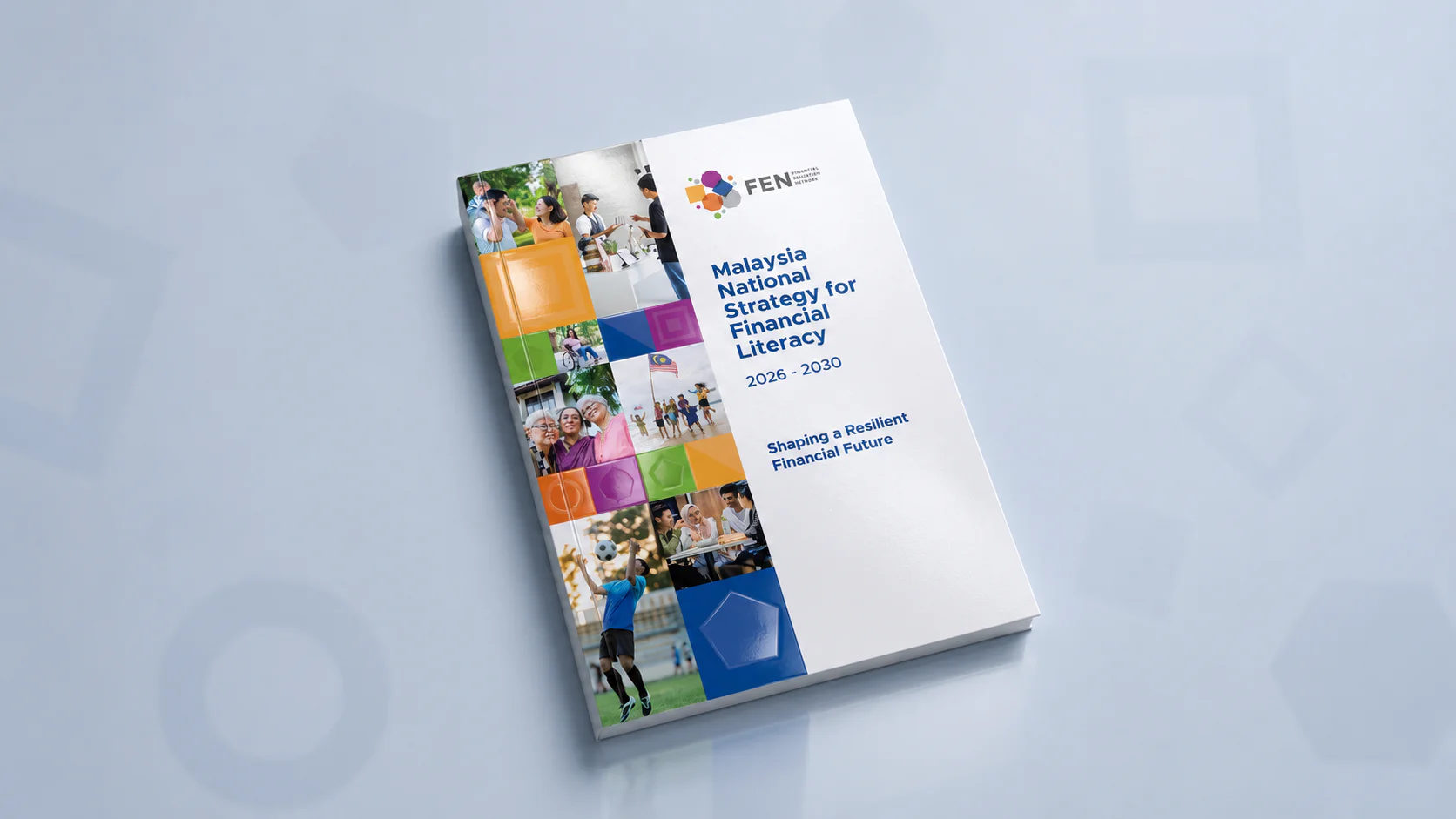
The National Strategy for Financial Literacy sets out Malaysia’s priorities for financial education across the strategy period. It covers life-stage learning, digital financial literacy, inclusion of vulnerable groups and multi-stakeholder collaboration. The publication needed to communicate these priorities to a wide range of audiences.
Walk Production delivered the design and production scope of this national impact report design. The work included bilingual editions in English and Bahasa Malaysia, interactive PDF versions and printed copies for stakeholder distribution.
Our Solutions
Conceptual framework for a strategy document
A national strategy document needs to read for two audiences at once: policymakers reviewing it for direction, and implementation partners working from it across different sectors. The team developed a layered information architecture that presents priorities upfront, with detailed implementation frameworks in subsequent sections.
Visual coding systems, including colour-coded priority areas, numbered action items and clear section navigation, allow readers to locate relevant content quickly. The approach supports both detailed reading and quick reference use across the document’s full length.
Data visualisation and visual design
The strategy’s infographic artwork translates national financial literacy data, demographic analyses and programme frameworks into visual formats. Process diagrams show how priorities interconnect. Timeline graphics communicate the phased implementation approach.
The visual identity balances the institutional tone expected of a government-backed publication with the accessibility needed for non-specialist readers. Clean layouts, generous spacing and readable typography make the document work across diverse audience segments.
Interactive PDF, print production and project management
Beyond the print edition, the team developed interactive PDF versions with clickable navigation, cross-referenced sections and hyperlinked resources. The digital editions let readers move between strategy components non-linearly, which suits a reference document stakeholders revisit over the strategy period.
Both English and Bahasa Malaysia editions were produced to identical design standards. Print production was coordinated for the full run, including delivery to stakeholder distribution points. Project management covered all phases from concept to delivery, with structured review milestones for government approval processes.
The Results
The strategy publication gives PIDM and FEN a document that serves both the regulatory mandate and the outreach objective. The layered design approach means different audiences can read the content at the level appropriate to their role.
Interactive PDF editions extend the document’s use as a working reference. Both the print and digital formats support the strategy’s implementation timeline with navigable, accessible content for all stakeholder groups.
Related Questions
How does the layered information architecture work in the PIDM strategy report?
Priorities are presented upfront, with detailed implementation frameworks in subsequent sections. Colour-coded priority areas, numbered action items and clear section navigation let readers locate relevant content quickly. A policymaker reviewing the document for direction reaches the priorities first; an implementation partner working from the document reaches the detailed frameworks where their work sits.
What did Walk Production deliver across the PIDM strategy report scope?
Conceptual development, visual and layout design, data visualisation, interactive PDF development, print production coordination and delivery, and project management. The end-to-end scope let PIDM and FEN focus on the strategy content and the government approval processes rather than coordinating the publication across multiple suppliers.
Why include process diagrams and timeline graphics in the PIDM strategy report?
The strategy is multi-year and involves multiple priorities running in parallel. Process diagrams show how priorities interconnect. Timeline graphics communicate the phased implementation approach. The visual layer makes the strategy’s structure readable in a way long-form policy text alone would not, which matters for a document that implementation partners are working from over the strategy period.